


How Can Business Owners Increase Company Value During an Economic Downturn?
An economic downturn is one of the best windows you have to increase the value of your company. A business that stays profitable and runs leaner during a slowdown is more resilient, harder for competitors to pick off, and far more marketable the day you decide to sell.
Key takeaways
- A downturn lets you make the business leaner and stronger, which raises its overall value rather than just helping it survive.
- Staying profitable keeps your five-year cash flow analysis strong and makes future growth projections more reliable to a buyer.
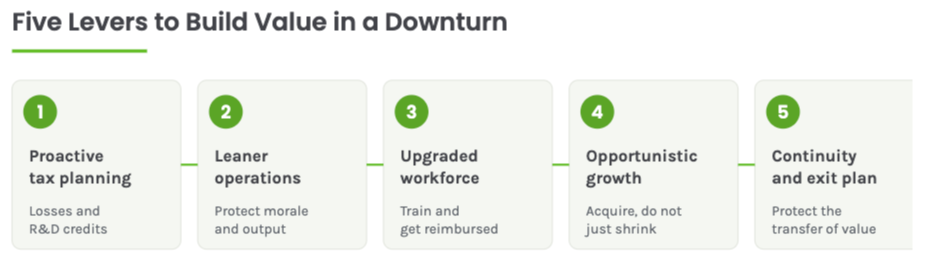
- Proactive tax planning, including single-year use of losses and R&D tax credits, can free up cash while rules are still favorable.
- Cut expenses in ways that do not disrupt operations or morale, and treat a downturn as a chance to grow through smart acquisitions.
- Revisit your continuity plan, exit timeline, and customer satisfaction now, before the next slowdown arrives.
Why Is a Downturn a Good Time to Build Business Value?
Economic downturns can be stressful for business owners. Riding the waves of rising revenue and profit during an upswing is the fun part, but being prepared for the downturns matters just as much, if not more, for two reasons.
The first is survival. You want the business to weather the storm with minimal sacrifices and without becoming more vulnerable to competitors. The second is opportunity. A downturn is the moment to make the company leaner and meaner and use the period to increase its overall value.
To keep the company marketable from a selling standpoint, you need to stay as profitable as possible so your five-year cash flow analysis stays strong and your future cash flow projections remain reliable. That strong cash flow picture is also the foundation of any serious retirement planning and business transition discussion when you are ready to step back. It is best to have a game plan ready to implement before the next downturn arrives, which could be right around the corner.
What Proactive Tax Moves Can Business Owners Make?
Start with tax planning, because many of the tax-saving tools in place today may be in jeopardy as the laws are likely to change. During the COVID-19 lockdown, many businesses used the PPP loan program. I think of that as a windfall government handout, and I doubt we will ever see that kind of program again. There are still action steps owners can take.
The first is using losses strategically in a single year. Your CPA will need to advise you here. Many businesses realized a net operating loss in a down year and then saw a drastic increase in profitability the next. If you expect to head into another downturn, you may want those losses carried forward to use in a single year to help minimize taxes, or you may choose to keep them for future years. Your accountant will know what fits your company, but it is worth looking into alongside your broader tax-efficient strategies.
The second is Research and Development Tax Credits, a potentially powerful tool for recapturing taxes paid to the federal government in previous years. Businesses such as manufacturers and technology firms that use capital expenditures to develop processes or software often qualify. According to an article published by Moss Adams, eligible start-ups and small businesses may claim up to $1.25 million, or $250,000 each year for up to five years, and a company must meet two requirements: have less than $5 million in gross receipts for the credit year, and have no gross receipts or interest income dating back more than five years. Several other guidelines apply, so confirm eligibility and current figures with your CPA before you count on them.
How Can You Upgrade Your Team Without Raising Costs?
Your workforce is the most valuable asset you have, so train your people and get reimbursed for it. For California business owners, the Employment Training Panel (ETP) runs a program built for exactly this. ETP is a business and labor supported state program that helps employers strengthen their competitive edge by providing funds to offset the cost of job skills training needed to maintain high-performance workplaces.
The funding upgrades employee skills so companies can compete globally. ETP primarily targets manufacturing, transportation and goods movement, high tech, agriculture, healthcare, construction, and clean tech. Build a customized training program that fits your needs and makes the business more competitive in the marketplace, which matters most during a downturn. Michael Snead of Sierra Consulting Services is an expert who helps owners get up and running in the ETP program.
Where Should You Cut Expenses Without Hurting Value?
Reducing overhead is an obvious move in a downturn, but the goal is to do it in a way that does not disrupt operations or employee morale. A few areas to look at first:
- Combine roles and responsibilities to deliver products or services more efficiently.
- Cancel or delay planned expansions or equipment purchases. It can make more sense to revisit those toward the end of the downturn cycle.
- Eliminate customers or lines of service that require a high level of human capital or a high degree of customization, both of which eat into profits.
Should You Shrink or Grow in a Downturn?
Downturns are not only for playing defense. With the right discipline, a slowdown is a chance to grow, often on terms that were not available a few months earlier. A handful of tactics are worth weighing:
- Purchase the customer list of a competitor who is closing their business.
- Acquire inventory, equipment, or staff from a smaller competitor. These are often best pursued toward the end of the cycle.
- Approach the seller of a company with seller financing and more flexible payment terms. Sellers are more open to alternative structures when bank financing and cash are both harder to come by.
It helps to see the defensive and offensive moves side by side so you can act on both at once:
| Defensive moves (protect value) | Offensive moves (build value) |
|---|---|
Combine roles to run more efficiently | Buy a closing competitor's customer list |
Delay planned expansions and equipment buys | Acquire inventory, equipment, or staff cheaply |
Drop high-cost, high-customization accounts | Use seller financing to acquire on flexible terms |
How Does a Downturn Affect Your Personal and Exit Plans?
A downturn can disrupt the personal plans you have for the business, so address three areas directly. The first is business continuity, or how the business carries on if something happens to you. A current buy-sell agreement is the backbone of business continuity planning, because it spells out who takes over and on what terms.
The second is your exit timeline. Ask whether your personal plans have changed and whether you need to adjust your target exit date. The third is family support. Consider whether family members need additional help and whether there are creative ways to provide it. As I have noted before, there is much to weigh when building the value of your company, with or without a downturn.
How Do You Make the Business More Valuable to a Future Buyer?
Improving growth potential is one of the clearest ways to raise value. Look at other markets you could enter and other products or services you could develop and introduce. Cross-selling existing products or services to current customers is another reliable growth lever.
Customer satisfaction matters just as much. Highly satisfied customers drive repeat purchases, word-of-mouth growth, brand loyalty, and recognition, so focus on your service operations. A good starting point is measuring how satisfied your customers really are by assigning an overall satisfaction score, most commonly through the Net Promoter Score.
Finally, prioritize where to focus by taking a business assessment. The ExitMap assessment consists of 22 questions, produces a 12-page report, and takes about 15 minutes to complete (ExitMap). It is a practical way to see which value drivers to work on first as you prepare for whatever the economy does next.
Have a Question This Article Did Not Cover?
At Zeller Kern Wealth Advisors, we help business owners across the greater Sacramento area build value, plan for continuity, and prepare for an eventual sale or transition. If you want to walk through how these ideas apply to your company, we would be glad to talk it through with you.